

COSMETIC:
(888) 803-3762
MEDICAL:
(519) 836-8558

03
Nov
ClearLift Laser in Guelph: What It Is, What the Studies Show and Who It Suits
ClearLift is a modest, low-downtime laser treatment for skin quality. Despite the name, it is not a lift, and it does not replace surgery or resurfacing. This guide explains what the treatment is, what it can reasonably be expected to do, what published studies of this laser class have found, and where the evidence is thin.
At deRMA Skin Institute in Guelph, the clinic says ClearLift is often incorporated into treatment plans under its 5 Dimension Skin Plan, which considers several factors behind visible skin aging.
Key Takeaways
- ClearLift is a fractional, non-ablative Q-switched Nd:YAG 1064 laser, which Alma Lasers lists as an applicator on its Harmony XL PRO platform.
- The clinic lists mild skin laxity, fine lines, uneven tone and mild texture changes. It does not list significant sagging.
- Only one of the studies quoted here names the Clear Lift laser; the others test other Q-switched 1064 lasers (several of them fractional) or compare laser types. The authors of one 252-patient series say substantial clinical data is lacking.
- The ten-woman study, on an Alma device named the Harmony XL, reported redness as the most common expected side effect. The study that names Clear Lift reported no significant adverse effects.
- The clinic says many patients benefit from three to five treatments, and results are not guaranteed.
What is ClearLift?
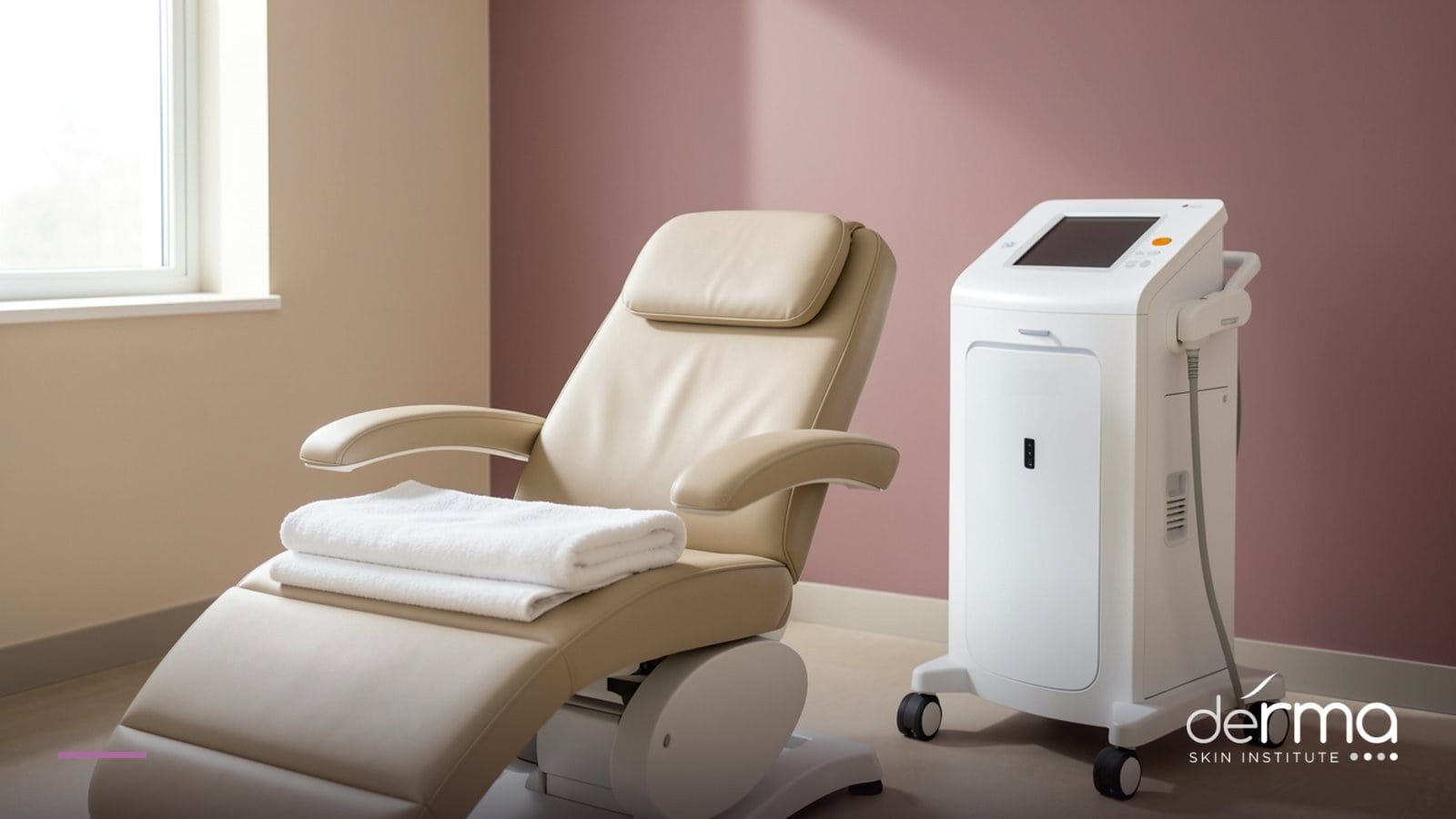
ClearLift is a fractional, non-ablative laser treatment. According to the deRMA ClearLift page, it uses Q-switched Nd:YAG 1064 energy to improve skin quality by targeting deeper layers of the skin. “Non-ablative” means the surface of the skin is not removed or disrupted.
Alma Lasers describes ClearLift as an applicator on its Harmony XL PRO platform, with an automated roller attachment for fast fractional treatments of the face, neck and body. The manufacturer describes the applicator as delivering intense nanosecond pulses.
The clinic explains the idea this way: controlled laser energy gently heats deeper tissue beneath the surface, which stimulates the skin’s natural repair processes, including collagen production and gradual skin renewal. The treatment is often called a “lunchtime facial” because of how little it interrupts a day.
What does ClearLift treat, and what will it not do?
ClearLift is aimed at early, mild changes in skin quality. The clinic lists these concerns:
- Fine lines and early wrinkles
- Mild skin laxity
- Uneven skin tone
- Sun damage
- Dull or tired-looking skin
- Mild textural irregularities
- Melasma (see the careful note on this below)
Because the delivery is gentle, the clinic says ClearLift can be used on delicate areas such as around the eyes and mouth, and that it is suitable for a wide range of skin types, including darker skin tones.
Here is where the name oversells it. The clinic’s own wording is “mild skin laxity.” The American Academy of Dermatology says a surgical lift, such as a facelift or eyelid surgery, gives the most dramatic results, and that other skin-tightening options offer less downtime. The AAD page does not mention ClearLift, and it says cost varies, so ask what a specific plan would cost. If your main concern is significant sagging, a consultation is the place to find out whether a different approach fits better.
Does ClearLift work? What the studies show
The studies report improvement, but the evidence base is modest. Most are small, several were in women only, and the study descriptions quoted here mention no untreated control group.
Only one of these studies names the ClearLift applicator. In a study published on PubMed, sixteen women aged 30 to 60 had three consecutive sessions with the Clear Lift laser on the Harmony XL-Pro at maximum energy. Face and neck were treated in eight patients, respectively. According to two blinded experts, the mean reduction in signs of skin aging on a Global Esthetic Improvement Scale was 30-40%.
Another PubMed-indexed study used an Alma Lasers device named the Harmony XL, a non-ablative fractional Q-switched 1,064-nm Nd:YAG laser. The sources do not say how it relates to the XL PRO. Ten women, aged 35 to 53 with skin types I to IV, had four sessions at 2-4 week intervals. Three months after the final treatment, 60% were graded with at least a one-point improvement on the Glogau global assessment.
A 2026 trial of a fractional Q-switched 1064 laser enrolled 36 women with Glogau type 1 to 3 facial wrinkles for four sessions. The investigator assessed fine lines, tone, tightness and texture, and three blinded assessors rated overall appearance. The abstract reports that optimal-dose treatments produced improved (27.8%) or much improved (72.2%) facial wrinkles within 3 months, without saying who gave that grade.
A series of 252 patients treated with fractional Q-switched 1064 for facial rejuvenation had 6 sessions at two-week intervals. Its authors add a caution that applies to this whole field: “there is lack of substantial clinical data to validate the clinical results.”
In other words, these results are encouraging but not conclusive, and they describe average responses. Your own result may differ.
What are the side effects?
The study that names Clear Lift reported no significant adverse effects. The ten-woman Harmony XL study reported that, of the expected side effects, erythema (redness) was most common, with pain rated between 0 and 2 on a 10-point scale and no unexpected adverse effects. The 252-patient series reported transient erythema in a few cases and noted no hypo- or hyperpigmentation. The other abstracts quoted here do not report redness.
The sixteen-woman study’s authors wrote that the procedure was “practically painless” with no significant adverse effects. That is their description of their own participants, not a promise. The clinic’s wording is that treatments are generally well tolerated, patients may hear light popping sounds and feel mild warmth, and numbing is not typically required.
What about hypopigmentation?
Two reports describe lightened patches of skin after Q-switched 1064 treatment, and it is worth understanding exactly what they cover. A case series of three patients developed guttate hypomelanotic macules on the face after laser toning with a Q-switched 1064-nm Nd:YAG. The authors describe laser toning as multiple, frequent, low-fluence, large-spot-size treatments, and say these are associated with macular hypopigmentation.
The case series abstract does not describe fractional treatment, so it neither shows this happened with fractional treatment nor shows that it cannot. A retrospective review of 40 Korean patients with Fitzpatrick skin type III to IV, treated for melasma with low-fluence Q-switched laser, likewise reported that two patients showed mottled hypopigmentation and rebound hyperpigmentation. The same laser type can be run at different settings, so ask your physician which settings are planned and what pigment risks apply to your skin type.
Is ClearLift a treatment for melasma?
The clinic lists melasma among ClearLift’s uses, but no single laser has been shown to be a definitive melasma solution. None of the melasma sources quoted here names ClearLift. A 2026 review on PubMed says Q-switched Nd:YAG and nonablative fractional lasers have shown promising results, “yet no single modality offers a definitive solution,” and that combination therapies, including oral or topical agents with lasers, yield better results.
The same review says maintenance is crucial to prevent recurrence, and that lasers must be approached cautiously because of post-inflammatory hyperpigmentation, especially in darker skin types.
One randomized trial of 60 patients with recalcitrant melasma compared three treatments, 20 patients each, over five sessions at 3-week intervals. One arm used a low-fluence pixel Q-switched Nd:YAG. All groups showed a highly significant reduction in the mMASI score, pixel Er:YAG reduced it the most, and no persistent or rebound pigmentation was observed.
Sun protection matters either way. The American Academy of Dermatology says sun protection can help fade melasma and prevent it from returning, and that a few studies found adding a laser or light treatment can improve results for patients already using medication and sun protection. Our melasma and hyperpigmentation page covers the wider options.
How many ClearLift sessions will you need, and when do results show?
The clinic says many patients benefit from a series of three to five treatments, spaced a few weeks apart depending on the condition being treated. It says patients typically notice gradual improvements in tone, texture and radiance 2-4 weeks after a treatment package, with results continuing to develop over 4-8 weeks as collagen production increases. Maintenance treatments every few months may be recommended.
For context, the AAD’s general guide to lasers that heat deep skin without wounding the top layer says you may need 3 to 5 treatments, with results gradually appearing between 2 and 6 months after the last treatment. The timelines differ, which is a good reason to ask what to expect for your concern. Little to no downtime, in the clinic’s words, means most patients can return to normal activities right after treatment.
How does ClearLift compare with other options?
The clinic describes ClearLift as a gentle, low-downtime option. This table uses only what the sources above state.
| Option | What the sources say |
|---|---|
| ClearLift | Non-ablative; the clinic describes little to no downtime and a series of three to five treatments |
| Surgical lift (facelift, eyelid surgery), per the AAD on skin-tightening options generally | The AAD says a surgical lift gives the most dramatic results; other options offer less downtime |
| Fractional picosecond vs fractional Q-switched Nd:YAG (a split-face trial; the Q-switched device is not named and is not identified as ClearLift) | No significant differences in clinical outcomes in 30 patients; the authors say the picosecond laser may offer superior collagen stimulation, albeit with higher pain levels |
The split-face trial, a 2025 study on PubMed, gave each patient a fractional picosecond laser on one side of the face and a fractional Q-switched Nd:YAG on the other, over five sessions. It concluded that both were effective and safe for improving photoaging. Because it does not name ClearLift, it is a comparison of laser types, not a ClearLift result.
For resurfacing and ultrasound-style tightening, our comparison of CO2 laser resurfacing, RF microneedling and Ultherapy goes through the differences. If your skin is sensitive, read the in-office treatments for sensitive skin and the ones to avoid first.
What should you know about ClearLift before and after photos?
Look at who treated the case. The gallery’s captions credit the doctor who provided each case.
You can view the cases in the ClearLift before and after gallery. When you do, check who treated each case, how many sessions were done and how long after the last one the photo was taken. The clinic states that each patient is unique and results may vary.
Frequently Asked Questions
Is ClearLift the same as a facelift?
No. ClearLift is a non-ablative laser treatment aimed at skin quality. The AAD says a surgical lift gives the most dramatic results. The clinic lists mild skin laxity among its uses and does not list significant sagging. A consultation is the way to learn whether it fits your concern.
Does ClearLift hurt?
In the one study that names the Clear Lift laser, the authors called the procedure “practically painless.” A separate study, on an Alma device named the Harmony XL, rated pain 0 to 2 out of 10. The clinic says treatments are generally well tolerated, with light popping sounds and mild warmth, and numbing not typically required. Sensation varies between people, so ask what to expect for the area being treated.
How many ClearLift treatments are needed?
The clinic says many patients benefit from three to five treatments, spaced a few weeks apart depending on the condition. Maintenance treatments every few months may be recommended. The number depends on your concern and skin, and the clinic says results are cumulative, so your physician will set a plan after assessing you.
Can ClearLift treat melasma?
The clinic lists melasma among ClearLift’s uses, but a 2026 review found no single laser offers a definitive solution, and none of the melasma sources quoted here names ClearLift. Combination therapy with topical or oral agents tends to do better, maintenance matters, and darker skin types carry a higher risk of post-inflammatory hyperpigmentation. Sun protection matters alongside any laser.
Book a ClearLift consultation in Guelph
If you are weighing ClearLift, a consultation is the way to find out whether it fits your skin, your concern and your timeline, or whether another option would suit you better. Read more on the ClearLift page, then reach us through the contact page or call the cosmetic line at (888) 803-3762.
Sources
- deRMA Skin Institute, “ClearLift,” retrieved 2026-11-03, https://dermaskininstitute.com/clearlift/
- Alma Lasers, “Harmony XL PRO,” retrieved 2026-11-03, https://almalasers.com/product/harmony-xl-pro/
- American Academy of Dermatology, “Firm sagging skin,” retrieved 2026-11-03, https://www.aad.org/public/cosmetic/younger-looking/firm-sagging-skin
- American Academy of Dermatology, “Melasma treatment,” retrieved 2026-11-03, https://www.aad.org/public/diseases/a-z/melasma-treatment
- PubMed, sixteen-woman Clear Lift study, retrieved 2026-11-03, https://pubmed.ncbi.nlm.nih.gov/32054353/
- PubMed, ten-woman Harmony XL study, retrieved 2026-11-03, https://pubmed.ncbi.nlm.nih.gov/24215422/
- PubMed, 252-patient fractional Q-switched Nd:YAG series, retrieved 2026-11-03, https://pubmed.ncbi.nlm.nih.gov/31207031/
- PubMed, 36-woman 2026 trial, retrieved 2026-11-03, https://pubmed.ncbi.nlm.nih.gov/41667697/
- PubMed, split-face fractional picosecond versus Q-switched trial, retrieved 2026-11-03, https://pubmed.ncbi.nlm.nih.gov/40589289/
- PubMed, 60-patient melasma trial, retrieved 2026-11-03, https://pubmed.ncbi.nlm.nih.gov/31010346/
- PubMed, 2026 melasma laser review, retrieved 2026-11-03, https://pubmed.ncbi.nlm.nih.gov/42303356/
- PubMed, laser toning hypomelanotic macules case series, retrieved 2026-11-03, https://pubmed.ncbi.nlm.nih.gov/26719647/
- PubMed, Korean melasma patients review, retrieved 2026-11-03, https://pubmed.ncbi.nlm.nih.gov/30280474/
Dusan Sajic, MD, PhD
Richard Backstein, MD
Sonja Sajic, CCPA

Toni Alberto, CCPA
With more than 20 years of experience, deRMA Skin Institute strive to offer patients the most advanced treatments available to keep their skin healthy and looking its best. Board Certified Dermatologist, Dusan Sajic, MD, PhD, board-certified Plastic and Reconstructive Surgeon, Richard Backstein, MD, FRCSC, Sonja Sajic, CCPA, and Toni Alberto CCPA are committed to providing state-of-the-art medical, surgical and cosmetic treatments to all patients in Guelph, Cambridge, Kitchener, Hamilton, Milton, and surrounding areas.
Contact Us
Fields marked * are required
If you are an existing patient inquiring about appointments and services, please contact
Guelph Cosmetic Department: (888) 803-3762 cosmetic@dermaskininstitute.com
Guelph Medical Department: (519) 836-8558 patientcare@dermaskininstitute.com