


COSMETIC:
(888) 803-3762
MEDICAL:
(519) 836-8558

16
Mar
CO2 Laser vs Fraxel vs RF Microneedling vs PRP: A Dermatologist’s Guide to Choosing Skin Resurfacing
TL;DR: The newest head-to-head research says the honest answer most clinics won’t give you: for acne scars, RF microneedling and fractional CO2 laser deliver essentially equal results. What differs is everything around the result: CO2 means about five days of downtime and a higher chance of temporary dark spots, while RF microneedling usually means next-day recovery and a cleaner safety record in deeper skin tones. Fraxel-type lasers sit between the two, PRP is an amplifier rather than a standalone, and the right choice depends on your scar type, skin tone, and how much recovery time you can give it. That’s a diagnosis, not a menu pick.
In 2024, Americans underwent more than 3.7 million skin-resurfacing procedures, with laser resurfacing growing 6% in a single year (American Society of Plastic Surgeons, 2024 Procedural Statistics Report). The demand is easy to understand. The decision is not. Between fractional CO2, Fraxel-type lasers, RF microneedling, and PRP treatments, patients face a wall of similar-sounding options, each marketed as the best.
Here’s what the clinical evidence actually shows about how these treatments differ, and how we match them to skin at deRMA Skin Institute in Guelph. Not marketing claims. Published trials, including a 2026 randomized study that changes the conventional wisdom about which treatment “wins.”
Key Takeaways
In a 2026 randomized split-face trial, RF microneedling matched fractional CO2 laser for acne-scar improvement (~44% vs ~42% scar-score reduction), with shorter redness, less swelling, and fewer pigment problems (Journal of Dermatological Treatment, 2026).
Fractional CO2 typically produces 30-70% acne-scar improvement over 2-4 sessions, at the cost of roughly 5 days of downtime (Life, systematic review, 2025).
Scar type changes the answer: 1550nm fractional lasers reduced boxcar scars by a median 59%, but icepick scars by only 19% (Dermatology and Therapy, 2023).
Adding PRP to microneedling roughly triples the odds of a greater-than-50% scar improvement (Frontiers in Medicine meta-analysis, 2022).
The Short Answer: How the Four Treatments Compare
Every option below remodels collagen. The meaningful differences are depth, downtime, pigment risk, and which scar patterns respond. Here’s the decision-level view, with the details and evidence for each in the sections that follow.
| Treatment | Best suited for | Typical downtime | Typical course | Pigment-risk profile |
|---|---|---|---|---|
| Fractional CO2 laser | Deeper texture damage, etched scars, significant sun damage | ~5 days off work | 2-4 sessions | Highest of the four; preventable with protocol |
| Fraxel-type (non-ablative fractional) | Boxcar and rolling scars, tone and texture, gradual improvement | 1-3 days of redness | 2-5 sessions | Moderate; density settings matter |
| RF microneedling | Acne scars with equal-to-CO2 results, early laxity, deeper skin tones | Often next day | ~3 sessions | Lowest laser-class risk; strongest skin-of-color record |
| PRP + microneedling | Amplifying results and healing alongside microneedling | 1-2 days | 3-4 sessions | Low |
Fractional CO2 Laser: The Deep Remodeler
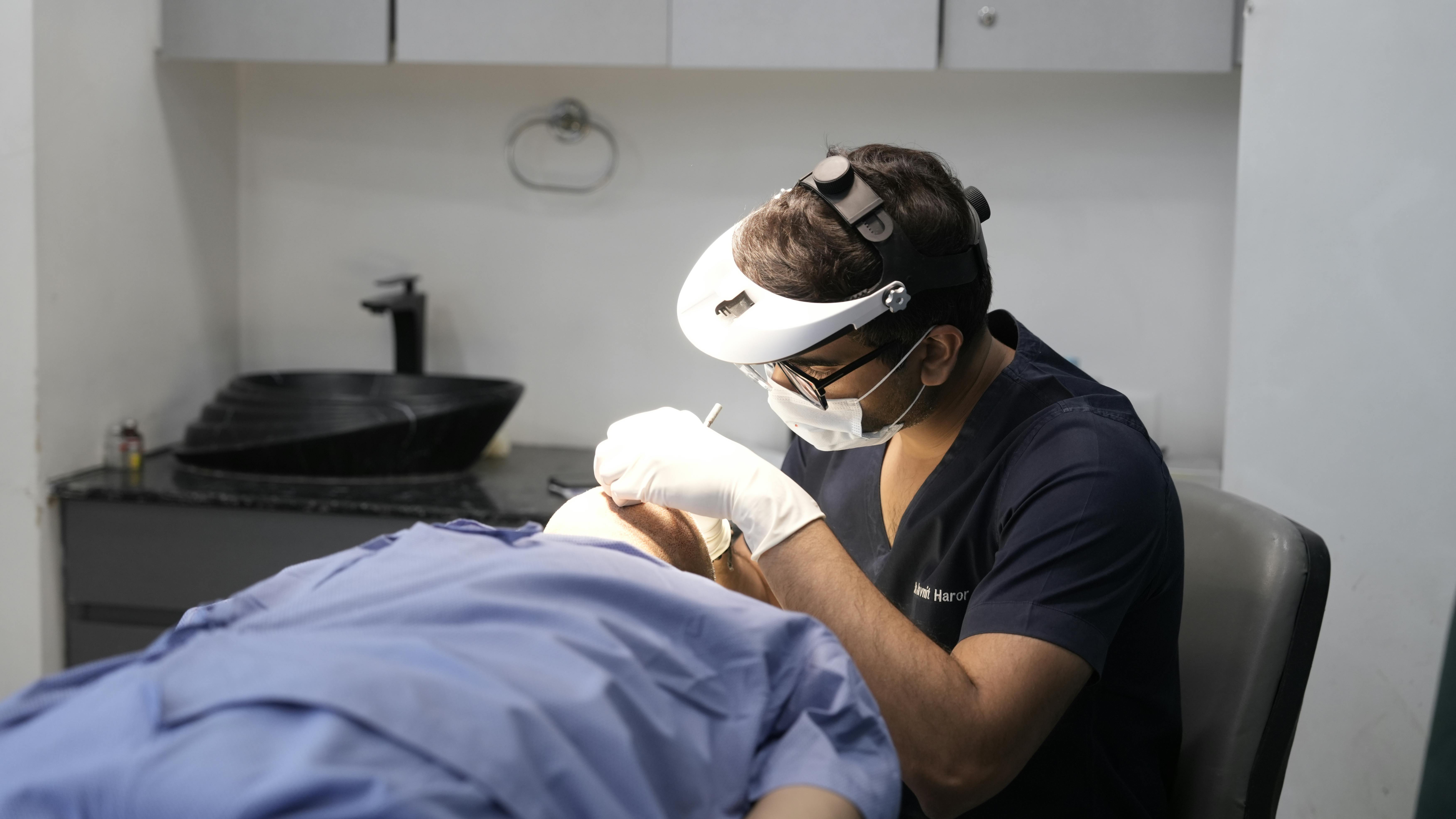
Fractional CO2 laser is an ablative treatment. In plain terms, it removes microscopic columns of skin and triggers the most aggressive collagen-remodeling response of any option in this guide. Across a 2025 systematic review of seven studies, most patients achieved 30-70% improvement in acne-scar appearance, typically over 2-4 sessions spaced a few weeks apart (Life, 2025). Consequently, CO2 remains the reference standard for significant textural damage. In my practice, it’s the tool I reach for when scarring is deep, etched, and long-established.
However, the trade-off is recovery. In a comparative study, CO2 patients needed about five days away from work. RF microneedling patients, by contrast, typically returned the next day (Journal of Cutaneous and Aesthetic Surgery, 2024). During those first days, skin is raw, red, and weeping. That’s not a complication. That’s the treatment working as designed.
There’s also a pigment story that deserves honest telling. In that same study, 12.5% of CO2 patients developed post-inflammatory hyperpigmentation (temporary dark patches after treatment, often called PIH). Meanwhile, the RF microneedling group had none. But here’s the nuance most summaries miss. A 2023 review of 313 patients found that PIH risk is heavily protocol-dependent, not just skin-type-dependent. In fact, preventive measures cut PIH incidence meaningfully, and the authors concluded that Fitzpatrick skin type alone did not predict who developed it (Dermatology Reports, 2023). In other words, prevention planning matters as much as device selection. That’s exactly why this decision belongs in a dermatologist’s hands rather than on a price list.
We offer this treatment as eCO2 laser skin resurfacing, and cover the recovery process in detail in our guide to CO2 laser resurfacing in Ontario.
Fraxel-Type Lasers: Precision Without the Full Downtime
Non-ablative fractional lasers like Fraxel are the middle path. Instead of removing tissue, they heat columns of deeper skin while leaving the surface largely intact. The result: less downtime, more sessions, and a subtler arc of improvement.
What’s genuinely useful about the Fraxel-class evidence is how it breaks down by scar type. For instance, in a 2023 study, the 1550nm fractional laser reduced boxcar scar counts by a median of 59.2% and rolling scars by 40.6%. Icepick scars, however, improved by only 19.1% (Dermatology and Therapy, 2023). So if your scarring is mostly the deep, narrow icepick pattern, a plan built around this laser alone will underdeliver, no matter how good the device is. In my experience, this is the single most common mismatch patients arrive with after treatment elsewhere: the device was fine, but nobody diagnosed the scar pattern first.
For deeper skin tones, the evidence supports a conservative-settings approach: in patients with Fitzpatrick types IV-VI, lower-density treatment was just as effective as high-density while producing fewer pigment changes (Dermatologic Surgery, 2016). Gentler settings, same result, safer skin. We also combine this class of laser with RF microneedling in Sylfirm + Fraxel combination protocols when texture and tone both need work.
RF Microneedling: The Evidence Shift of 2026
Why is RF microneedling suddenly the treatment dermatologists keep recommending? Because the head-to-head data caught up with the clinical hunch.
RF microneedling is a hybrid: fine needles deliver radiofrequency energy into the deeper skin layers, remodeling collagen from below while barely disturbing the surface. And in 2026, the head-to-head evidence arrived. In a randomized split-face trial, patients received RF microneedling on one side of the face and fractional CO2 on the other, for three sessions each. Scar scores fell by roughly 44% on the RF microneedling side and 42% on the CO2 side. That difference wasn’t statistically significant, meaning the two treatments performed equally on the outcome that matters most. The RF microneedling side, meanwhile, had shorter redness, less pain and swelling, faster healing, and fewer pigment problems (Journal of Dermatological Treatment, 2026). Equal results, easier recovery. For many of our Guelph patients, especially those who can’t take a week away from work or clients, that trade decides the whole plan.
Similarly, an earlier Danish randomized trial found the same equal-efficacy pattern after just a single session. Each modality showed a different discomfort profile, though. CO2 caused more post-treatment rawness and redness at days 2-4. RF microneedling, on the other hand, hurt more during the procedure itself (Lasers in Surgery and Medicine, 2023). Additionally, a systematic review of 16 studies covering 481 patients confirmed RF microneedling works as a standalone scar treatment, not just as an add-on (Clinical, Cosmetic and Investigational Dermatology, 2025).
We offer this treatment class as RF microneedling, including Morpheus8, with results in our before-and-after gallery.
What About Deeper Skin Tones?
This is where treatment selection genuinely changes, and where the evidence is worth spelling out. A review of 35 studies examined RF and RF microneedling in Fitzpatrick skin types III-VI (the classification dermatologists use for medium to deeply pigmented skin). The finding: pigment changes were transient in nearly every reported case, and the authors concluded these treatments carry a low dyspigmentation risk in skin of color (Dermatologic Surgery, 2023).
Compare that with the laser data: in a randomized trial, 13.6% of patients treated with a non-ablative fractional laser developed temporary hyperpigmentation versus zero in the microneedling group (Dermatologic Surgery, 2016). To be clear, none of this makes lasers wrong for deeper skin tones. It makes unplanned lasers wrong. With conservative densities, preventive protocols, and honest expectations, fractional lasers remain on the table for Fitzpatrick IV-VI. But when the result is equivalent anyway, as the 2026 trial showed, RF microneedling often earns first position for melanin-rich skin. That’s how we sequence it in our own treatment planning.
PRP: The Amplifier, Not the Headliner
Platelet-rich plasma (PRP) is your own blood, spun down to concentrate the growth-factor-rich fraction, then returned to the skin during microneedling. The right way to think about it: PRP doesn’t replace a resurfacing treatment, it amplifies one. In our clinic, that’s exactly how we position it during consultations.
The pooled data is convincing. Across 14 studies and 472 patients, adding PRP to microneedling roughly tripled the odds of achieving a greater-than-50% scar improvement, and quadrupled the odds of patient-reported satisfaction, without increasing serious side effects (Frontiers in Medicine meta-analysis, 2022). One honest caveat we always attach: most of those studies were small and their PRP preparations varied, so the size of the boost is better established than its exact number.
Full details on our approach are on the PRP microneedling page, and in our guides to why PRP and microneedling work together and PRP for acne scars specifically.
Where Does Ultherapy Fit?
Patients ask us about Ultherapy constantly. However, it belongs in a different lane than everything above. Ultherapy is a microfocused ultrasound treatment aimed at lifting and laxity, not surface texture or scarring. In its key clinical study, blinded reviewers saw measurable lower-face tightening in 58.1% of patients at 90 days, and about two-thirds of patients reported improvement themselves (Aesthetic Surgery Journal, 2014).
The same study carries an honest patient-selection lesson: among participants with a BMI over 30, more than half showed no detectable change. Ultrasound tightening has real but bounded effects, and candidacy screening determines satisfaction. If your primary concern is laxity rather than texture, that’s a conversation about tightening options, including AccuTite, Evolve, and RF-based approaches, rather than resurfacing.
Can These Treatments Be Combined?
Often, yes — and for mixed damage patterns, combination is frequently the right answer rather than an upsell. Because most faces carry more than one type of damage (say, rolling scars plus early laxity plus sun-related tone changes), single-device plans tend to chase one problem while ignoring the rest.
The combinations we use most at deRMA follow the evidence in this article. PRP layered onto microneedling, per the meta-analysis data above, roughly triples the odds of a strong scar result. Sequential protocols pair a Sylfirm RF microneedling and Fraxel-type laser combination so texture and pigment get addressed by the tool best suited to each. And for patients whose priority is laxity as much as texture, resurfacing can be staged alongside tightening treatments like AccuTite rather than forced into one device’s capabilities.
The sequencing matters as much as the selection, however. Aggressive treatments need healing windows between them, and combining modalities changes the settings each should run at. That’s planning work, and it’s exactly what the consultation exists for.
So Which Treatment Is Right for You?

After all the trial data, the decision comes down to four questions we work through in every consultation:
- What’s the actual damage pattern? Icepick scars, boxcar scars, rolling scars, sun damage, and laxity each respond to different tools, and most faces have a mix. This single assessment changes the plan more than any device preference.
- What’s your skin tone and pigment history? Deeper skin tones shift the risk math toward RF microneedling first, or carefully-planned laser protocols with prevention built in.
- How much downtime can you actually take? Five days of visible recovery buys the most aggressive single-treatment remodeling; next-day options get to a similar endpoint over more sessions.
- Is amplification worth it? If microneedling is on your plan, the PRP data argues strongly for pairing them.
Persistent acne scarring is also worth treating sooner rather than later. Our acne scar resurfacing and acne scarring pages cover the full treatment map, including options this article doesn’t cover like chemical peels and ClearLift.
Request a consultation and we’ll build the plan around your skin rather than a device menu.
Frequently Asked Questions
Is RF microneedling really as effective as CO2 laser for acne scars?
For atrophic acne scars, yes, per the newest randomized evidence: a 2026 split-face trial found statistically equivalent scar-score reductions (about 44% vs 42%) after three sessions, with faster recovery and fewer pigment problems on the RF microneedling side (Journal of Dermatological Treatment, 2026). CO2 retains advantages for certain deep, etched textural damage.
How much downtime should I plan for?
Roughly five days away from work for fractional CO2, versus next-day return for RF microneedling in comparative research (Journal of Cutaneous and Aesthetic Surgery, 2024). Fraxel-type lasers typically sit between the two with a few days of redness rather than open recovery.
Which treatment is safest for darker skin?
RF microneedling has the strongest published safety record in Fitzpatrick types III-VI: across 35 studies, pigment changes were transient in nearly all reported cases (Dermatologic Surgery, 2023). Lasers remain usable with conservative settings and preventive protocols, since research shows prevention planning influences pigment risk as much as skin type does (Dermatology Reports, 2023).
How many sessions will I need?
Typical published courses: 2-4 sessions for fractional CO2, 2-5 for Fraxel-type lasers, and about 3 for RF microneedling, spaced several weeks apart. Icepick-dominant scarring often needs a combination plan, since even effective lasers reduced icepick scars by only about 19% in scar-type research (Dermatology and Therapy, 2023).
Is adding PRP to microneedling worth the extra cost?
The pooled evidence says usually yes: across 14 studies, PRP roughly tripled the odds of a greater-than-50% scar improvement and quadrupled satisfaction odds versus microneedling alone (Frontiers in Medicine, 2022). Whether it’s right for your plan depends on your scar pattern and goals, which is a consultation-level call.
Medically reviewed by Dr. Dusan Sajic, MD, PhD — dermatologist, deRMA Skin Institute, Guelph, ON.
Sources
- American Society of Plastic Surgeons, “2024 Procedural Statistics Report,” retrieved 2026-08-11, https://www.plasticsurgery.org/documents/news/statistics/2024/plastic-surgery-statistics-report-2024.pdf
- Ptaszek et al., “The Use of a Fractional Laser in Acne Scar Treatment — A Systematic Review,” Life (Basel), 2025, https://pmc.ncbi.nlm.nih.gov/articles/PMC12194615/
- Sriram, Chandrashekar et al., comparative study, Journal of Cutaneous and Aesthetic Surgery, 2024, https://pmc.ncbi.nlm.nih.gov/articles/PMC11494830/
- Bin Dakhil, Shadid, Altalhab, “Post-inflammatory hyperpigmentation after carbon dioxide laser: review of prevention and risk factors,” Dermatology Reports, 2023, https://pubmed.ncbi.nlm.nih.gov/38205425/
- Lee & Cho, “Clinical Factors Affecting the Effectiveness of 1550-nm Erbium-Doped Fractional Photothermolysis Laser for Individual Atrophic Acne Scar Types,” Dermatology and Therapy, 2023, https://pmc.ncbi.nlm.nih.gov/articles/PMC9884716/
- Alexis et al., “Nonablative Fractional Laser Resurfacing for Acne Scarring in Patients With Fitzpatrick Skin Phototypes IV-VI,” Dermatologic Surgery, 2016, https://pubmed.ncbi.nlm.nih.gov/26945321/
- Li et al., “Comparative efficacy, recovery, and pigmentary safety of radiofrequency microneedling and fractional carbon dioxide laser for facial atrophic acne scars: a prospective randomized split-face trial,” Journal of Dermatological Treatment, 2026, https://pubmed.ncbi.nlm.nih.gov/42312398/
- Niaz et al., “Fractional Radiofrequency Microneedling as a Monotherapy in Acne Scar Management: A Systematic Review,” Clinical, Cosmetic and Investigational Dermatology, 2025, https://pubmed.ncbi.nlm.nih.gov/39781098/
- Syder, Chen, Elbuluk, “Radiofrequency and Radiofrequency Microneedling in Skin of Color: A Review of Usage, Safety, and Efficacy,” Dermatologic Surgery, 2023, https://journals.lww.com/dermatologicsurgery/abstract/2023/05000/radiofrequency_and_radiofrequency_microneedling_in.10.aspx
- Kang & Lu, “Combined Effect of Microneedling and Platelet-Rich Plasma for the Treatment of Acne Scars: A Meta-Analysis,” Frontiers in Medicine, 2022, https://pmc.ncbi.nlm.nih.gov/articles/PMC8882957/
- Hendel, Karmisholt, Hedelund, Haedersdal, “Fractional CO2-laser versus microneedle radiofrequency for acne scars: A randomized, single treatment, split-face trial,” Lasers in Surgery and Medicine, 2023, https://pubmed.ncbi.nlm.nih.gov/36934435/
- Cachafeiro et al., “Comparison of Nonablative Fractional Erbium Laser 1,340 nm and Microneedling for the Treatment of Atrophic Acne Scars: A Randomized Clinical Trial,” Dermatologic Surgery, 2016, https://pubmed.ncbi.nlm.nih.gov/26845539/
- Oni et al., “Evaluation of a Microfocused Ultrasound System for Improving Skin Laxity and Tightening in the Lower Face,” Aesthetic Surgery Journal, 2014, https://academic.oup.com/asj/article-abstract/34/7/1099/2801381

Dusan Sajic, MD, PhD
Richard Backstein, MD

Sonja Sajic, CCPA

Toni Alberto, CCPA
With more than 20 years of experience, deRMA Skin Institute strive to offer patients the most advanced treatments available to keep their skin healthy and looking its best. Board Certified Dermatologist, Dusan Sajic, MD, PhD, board-certified Plastic and Reconstructive Surgeon, Richard Backstein, MD, FRCSC, Sonja Sajic, CCPA, and Toni Alberto CCPA are committed to providing state-of-the-art medical, surgical and cosmetic treatments to all patients in Guelph, Cambridge, Kitchener, Hamilton, Milton, and surrounding areas.
Contact Us
Fields marked * are required
If you are an existing patient inquiring about appointments and services, please contact
Guelph Cosmetic Department: (888) 803-3762 cosmetic@dermaskininstitute.com
Guelph Medical Department: (519) 836-8558 patientcare@dermaskininstitute.com